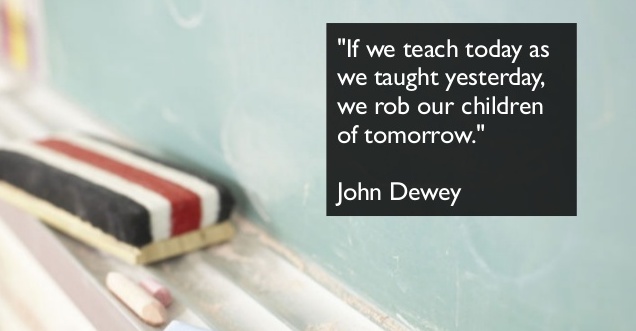
According to Will Richardson's description of his vision for "new school" is:
"...it's about asking questions, working with others to find the answers, doing real work for real audiences, and adding to, not simply taking from, the storehouse of knowledge that the Web is becoming. It's about developing the kinds of habits and dispositions that deep, lifelong learners need to succeed in a world rife with information and connections. The emphasis shifts from content mastery to learning mastery."I'm on board. I have never heard it said so succinctly and clearly. Yes! I want to do this! My fear is that I don't know how to do this. It's definitely easier to stick to the old school model, is it not? In grade school, I was the kid for whom rote memory was no problem. I'm not one to ask hard questions and, honestly, I had a terrible time thinking critically about the articles that I read in history courses in university. Asking questions is not my forte. I don't want to share my work with real audiences because what if they criticize me? Who am I to add to "the storehouse of knowledge that is the Web"? But after voicing all these concerns, I think to myself, I'm going to have to figure it out. Like I said, I'm on board.
So, HOW do I tangibly "get on board"? It's not by researching some of those links that I posted in my last blog post. This is almost a "re-do" of my previous reading response #2 but this time, I will break down the suggestions Richardson gives in Why School?, and find resources to begin "unlearning" what I know, and relearn these new school practices.
>> 1. Share everything (or at least something): sharing comes in many forms: blogging our reflections, capturing video of our process, etc.
>> 2. Discover, don't deliver, the curriculum:
"Teachers need to be great at asking questions and astute at managing the different paths to learning that each child creates. They must guide students to pursue projects of value and help them connect their interests to the required standards. And they have to be participants and models in the learning process." (Richardson)
Child-driven Education TedTalk
Mitra has completed many experiments in which he gives groups of children computers and watches what happens. He describes the effect of a "Granny", who simply admires what the group of children are doing and asks things, "can you do that again?" Other points of interest:
- children can learn anything that they are interested in
- a single child in front of a single computer will not retain as much as a group of children around a single computer because of the discussion that takes place.
Project-Based Learning Research Review
I think Project-Based Learning aligns with this section that Richardson is describing. It's definitely a buzz-word around my school and I'm not sure I truly understood the sense of the term until now. This articles is an excellent overview of this term, recommendations for putting it into practice, tips for avoiding pitfalls, and a bibliography for further exploration.
How to Create a Personal Learning Portfolio: Students and Professionals
Because we need a way to document, reflect on, and assess learning, Richardson suggested students prepare personal digital portfolios. In this article, Morrison gives an excellent breakdown of the steps in which students should follow in order to do this.
>> 3. Talk to strangers:
Classroom Champions
This website connects classrooms of students with professional athletes to teach health, career, and character-building skills via Skype or Google Hangouts. Then they continue to connect that same athlete multiple times so that they build a relationship.
Is Twiducate worth looking into? Has anyone used it before? It looks like it could be a cool way to connect students to other groups of students for collaboration but I'm not spending a ton of time on the site. However, I would love to hear your feedback if you've used it.
>> 4. Be a master learner.
By doing this, students have to think hard about their audience, learn how to network and collaborate with others, and develop proficiency with the tools of technology.
To assess, "teachers could co-create rubrics with students that identify what their work should address and what quality looks like," (Richardson).
For students, the importance of doing work that matters.
This is an excellent summary of this section of Why School? that I could easily share with others (mostly my students' parents, likely) to describe why I'm trying to find ways for my students to create a project with meaning.
>> 6. Transfer the power.
Now that I have spent more time thinking about these six suggestions, breaking them down, and spending some time looking for what's out there, I know that there are lots of resources out there for me. I was intrigued by websites like educurious.org which seems to provide project-based units and connects students with experts in their network as well as Sugata Mitra's School in the Cloud website.
Am I still on board? Yes. I have now assessed the possibility of unlearning and deem the task both worthwhile and doable! As I went through each section, I was thinking about how I could share these six suggestions with my families who home school and possibly use my list of resources as tools for parents educating their kids at home. I am excited by some new possibilities that have popped up in my mind for the Vision Project.
Mitra, Sugata. "The child driven education." Newcastle University. TEDGlobal 2010, Oxford, England. July 2010.
Morrison, Debbie. "How to Create a Personal Learning Portfolio: Students and Professionals." Online Learning Insights. Online Learning Insights, 30 Jan. 2013. Web. 4 Oct. 2015
Richardson, Will. "For students, the importance of doing work that matters." Mindshift: How We Will Learn. KQED, 30 Apr. 2014. Web. 4 Oct. 2015.
Richardson, Will. Why School?. New York: TED Conferences LLC, 2012. Kindle edition.
Vega, Vanessa. "Project-Based Learning Research Review." Edutopia. Edutopia, 3 Dec. 2012. Web. 4 Oct. 2015.
Classroom Champions. Classroom Champions. n.p., 2012. Web. 4 Oct. 2015.
- children can learn anything that they are interested in
- a single child in front of a single computer will not retain as much as a group of children around a single computer because of the discussion that takes place.
Project-Based Learning Research Review
I think Project-Based Learning aligns with this section that Richardson is describing. It's definitely a buzz-word around my school and I'm not sure I truly understood the sense of the term until now. This articles is an excellent overview of this term, recommendations for putting it into practice, tips for avoiding pitfalls, and a bibliography for further exploration.
How to Create a Personal Learning Portfolio: Students and Professionals
Because we need a way to document, reflect on, and assess learning, Richardson suggested students prepare personal digital portfolios. In this article, Morrison gives an excellent breakdown of the steps in which students should follow in order to do this.
>> 3. Talk to strangers:
"The key, of course, is having the ability to find them, vet them, and bring them safely into the learning lives of your students. ... And, more important, it's a chance to teach kids how to do this for themselves." (Richardson)This is a tough one to research. I think this would have to be a case by case project, to connect your student with someone in the field that he's learning about.
Classroom Champions
This website connects classrooms of students with professional athletes to teach health, career, and character-building skills via Skype or Google Hangouts. Then they continue to connect that same athlete multiple times so that they build a relationship.
Is Twiducate worth looking into? Has anyone used it before? It looks like it could be a cool way to connect students to other groups of students for collaboration but I'm not spending a ton of time on the site. However, I would love to hear your feedback if you've used it.
>> 4. Be a master learner.
"People who model their own learning process, connect to other learners as a regular part of their day, and learn continuously around the things they have a passion for." "...[teachers] have to exhibit the dispositions that will sustain their learning: persistence, empathy, passion, sharing, collaboration, creativity, and curiosity." (Richardson)>>5. Do real work for real audiences.
By doing this, students have to think hard about their audience, learn how to network and collaborate with others, and develop proficiency with the tools of technology.
To assess, "teachers could co-create rubrics with students that identify what their work should address and what quality looks like," (Richardson).
For students, the importance of doing work that matters.
This is an excellent summary of this section of Why School? that I could easily share with others (mostly my students' parents, likely) to describe why I'm trying to find ways for my students to create a project with meaning.
>> 6. Transfer the power.
"If we expect our kids to be able to own their own learning, find their own teachers, create their own classrooms, and find other students to learn with, then we need to make sure they have opportunities to do these things in school." (Richardson)
****
Am I still on board? Yes. I have now assessed the possibility of unlearning and deem the task both worthwhile and doable! As I went through each section, I was thinking about how I could share these six suggestions with my families who home school and possibly use my list of resources as tools for parents educating their kids at home. I am excited by some new possibilities that have popped up in my mind for the Vision Project.
WORKS CITED
Morrison, Debbie. "How to Create a Personal Learning Portfolio: Students and Professionals." Online Learning Insights. Online Learning Insights, 30 Jan. 2013. Web. 4 Oct. 2015
Richardson, Will. "For students, the importance of doing work that matters." Mindshift: How We Will Learn. KQED, 30 Apr. 2014. Web. 4 Oct. 2015.
Richardson, Will. Why School?. New York: TED Conferences LLC, 2012. Kindle edition.
Vega, Vanessa. "Project-Based Learning Research Review." Edutopia. Edutopia, 3 Dec. 2012. Web. 4 Oct. 2015.
Classroom Champions. Classroom Champions. n.p., 2012. Web. 4 Oct. 2015.


